Ranges and Roles - Overview
The DSMC enables the delegation of individual tasks to members of staff who are to perform specific tasks, e.g. to the helpdesk, to software managers, or to local system operators.
Delegating tasks in the DSMC is based on the following concepts:
- Role concept: Tasks do not need to be assigned individually, but rather can be grouped together in roles
- Assigning
roles and ranges of action to role owners: You can specify a range
within the organization tree in which a user (who is role owner) can perform
specific tasks: a domain
 , a OU
  or a software
folder
or a software
folder - Using the optimum interface depending on the profile of the member of staff: You can independently specify whether a task can be executed in the DSMC or in the DSM Web.
Please note that you need a specific license for the DSM Web.
Roles, Tasks, Role Owners and Objects
The DSMC allows the implementation of hierarchical organization structures in its organization tree and in the software library. In order to secure this structure, role-based permissions can be defined:
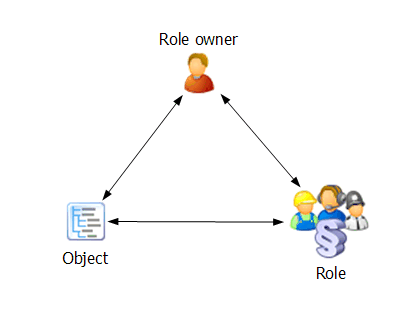
Figure: Relationships between role, role owner and objects of the organization tree. Klick on the hotspots for further information.
Specifying role-based permissions follows this procedure:
(1)
Tasks and roles
You can group different tasks with
different roles.
(2)
Role owners
You will assign specific users or user groups as role
owners to a specific role.
(3)
Assigning roles to objects in the organization tree
By assigning roles to specific objects you
can define a range within the organization tree in which a user (who is
role owner) can perform specific tasks (i.e. the tasks that belong to
"his" role): In the DSMC these organization ranges are domains
, OUs , groups, and software folders  .
.
A role that is assigned to an owner is always linked to an organization tree object and cannot be abstract.