GetGlobal
Returns the value of the global constant specified. See Working with Global Constants and Default Global Constants.
Syntax
GetGlobal(name)
Enabled For
For a description of the business object categories, see Notes on "Enabled For".
| Business Object Category | Yes/No |
|---|---|
| Business Rules: Before-Save Rules | Yes |
| Business Rules: Calculation Rules (After Save, with or without Also Recalculate on Load) | No |
| Business Rules: Calculation Rules (Before Save or Always, without Also Recalculate On Load) | No |
| Business Rules: Calculation Rules (Before Save or Always, with Recalculate On Load) | No |
| Business Rules: Editing Rules | No |
| Business Rules: Initialization Rules | Yes |
| Business Rules: Read Only Rules | No |
| Business Rules: Required Rules | No |
| Business Rules: Validation Rules | Yes |
| Client Expressions | Yes |
| Object Permissions | Yes |
| Services | Yes |
| LDAP | Yes |
| Mobile | Yes |
| Quick Actions (except UI Quick Actions) | Yes |
| UI Quick Actions | Yes |
| Reports | Yes |
| Search/Dashboard without field references | Yes |
| Search/Dashboard with field references | Yes |
Parameters
| Parameter | Description |
|---|---|
|
name |
The name of the global constant for which to see the value. |
Return Value
The same type as the value of the global constant. For example, if the global constant is a DateTime value, this function returns a DateTime value.
Example
GetGlobal() Example
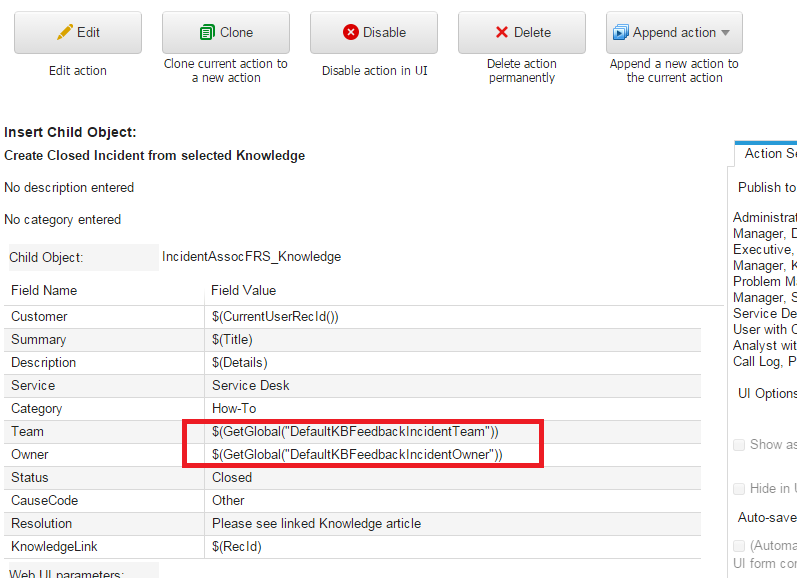
The above example uses the DefaultKBFeedbackIncidentTeam and DefaultKBFeedbackIncidentOwner global constants as the team and owner names.